
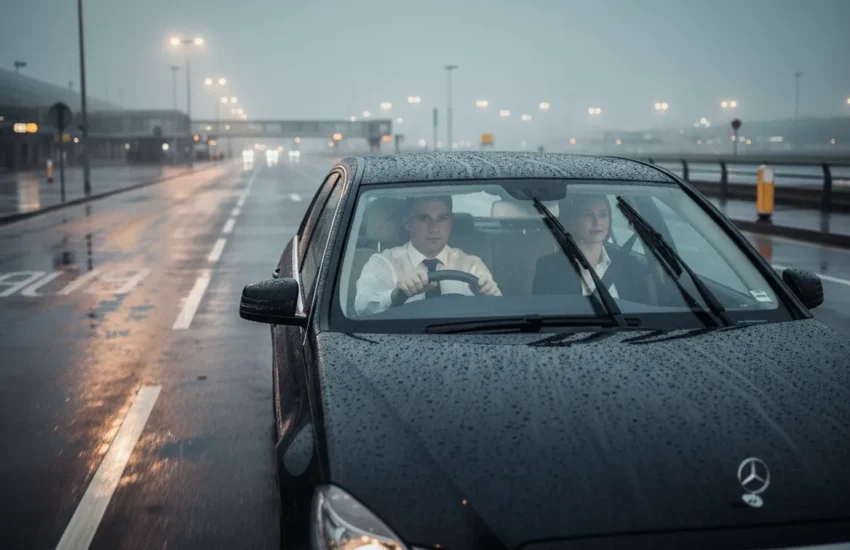
Executive Summary
Weather influences airport road access in London in ways that are often underestimated by passengers. While extreme conditions such as snow or ice are widely recognised as disruptive, moderate and common weather patterns—rain, wind, fog, and temperature variation—create more frequent and subtle impacts on travel reliability. These impacts are not limited to driving difficulty; they affect traffic behaviour, incident recovery time, road management decisions, and overall predictability.
Understanding how weather interacts with airport roads allows passengers to interpret delays accurately and avoid misattributing disruption to service failure when it is the result of systemic safety responses.
Why Is Weather a Structural Factor in Road Access?
Weather does not merely alter road conditions; it changes how the entire transport system behaves. Road networks operate within safety thresholds that are dynamically adjusted based on visibility, surface friction, and driver behaviour. When these thresholds shift, flow efficiency is intentionally reduced to maintain safety.
This reduction disproportionately affects airport access roads because of their funnel-like design and time-sensitive usage.
How Does Rain Influence Traffic Flow to Airports?
Rain is one of the most impactful weather variables in London. Even light rainfall:
- Reduces braking efficiency
- Increases stopping distances
- Encourages cautious driving behaviour
These changes slow traffic across the network. On airport-bound routes, where timing precision matters, the effect feels magnified.
Rain also increases the likelihood of minor incidents, which can create cascading delays even if road capacity remains technically available.
Why Does Fog Create Disproportionate Delays?
Fog reduces visibility and depth perception, prompting:
- Lower speed limits
- Increased lane discipline
- Greater driver hesitation at junctions
These behaviours extend travel time more through behavioural adaptation than physical obstruction.
How Do Wind Conditions Affect Road Reliability?
High winds influence vehicle stability, particularly for:
- High-profile vehicles
- Bridges and elevated road sections
Drivers naturally reduce speed, and authorities may impose temporary restrictions. These adjustments ripple through access corridors, increasing variance rather than uniform delay.
Why Does Cold Weather Increase Fragility Even Without Snow?
Cold temperatures reduce road surface grip and can create invisible hazards such as black ice. Even when conditions appear clear:
- Speed reductions occur
- Incident recovery slows
- Preventative road management measures activate
The system becomes fragile, meaning small disruptions have outsized consequences.
How Do Weather Conditions Interact With Road Maintenance?
Weather often coincides with:
- Emergency maintenance
- Drainage management
- Surface treatments
These activities may reduce lane availability temporarily, further constraining access during already sensitive periods.
Why Are Airport Roads More Vulnerable Than Through-Routes?
Airport access roads serve a concentrated purpose. Unlike through-routes, they:
- Cannot redistribute traffic easily
- Have limited alternative paths
- Operate under strict safety protocols
Weather-related slowdowns therefore accumulate quickly near terminals.
How Does Weather Affect Arrival Predictability More Than Travel Time?
Passengers often focus on average delay, but weather primarily increases uncertainty. Arrival times become less predictable, even if overall delays remain modest. This unpredictability causes stress and dissatisfaction disproportionate to the actual delay duration.
Why Do Digital Travel Estimates Struggle During Weather Events?
Navigation systems rely on historical and real-time data. Weather introduces:
- Sudden behaviour changes
- Incident clustering
- Variable recovery rates
As a result, estimates lag behind reality during evolving conditions.
How Should Passengers Mentally Adjust Expectations During Weather Disruptions?
Effective adjustment involves:
- Allowing wider time buffers
- Expecting variability rather than precision
- Recognising safety-driven slowdowns as intentional
This mental reframing improves experience even when conditions are suboptimal.
