
Executive Summary
Family travel is often misclassified as a simplified form of group travel. In reality, it is one of the most complex travel contexts within London’s private transport ecosystem. Unlike adult group journeys, family travel introduces asymmetrical needs: children require different safety standards, movement patterns differ, luggage behaves differently, and time sensitivity becomes emotional rather than purely logistical.
This article explains family travel as a contextual system, not a passenger category. It explores how family dynamics interact with vehicle suitability, safety regulation, airport environments, and psychological comfort. Rather than offering checklists, it reframes family travel planning as a process of reducing uncertainty and protecting dependents under real-world constraints.
Why Family Travel Is Structurally Different From Other Travel Types
Family travel is not simply “multiple passengers travelling together.” It is defined by dependency relationships. In a family, not all passengers have equal autonomy, awareness, or tolerance for discomfort. Adults adapt; children react.
This difference changes how travel must be planned. Decisions that might be acceptable for adult travellers—tight seating, delayed departures, improvised luggage placement—carry higher consequences when children are involved. What is mildly inconvenient for an adult can be overwhelming for a child.
As a result, family travel requires predictability over efficiency and stability over optimisation.
How Children Change the Meaning of Time in Travel
Time behaves differently in family travel. Adults can absorb delays cognitively; children experience them physically and emotionally. A ten-minute wait feels longer to a child because they lack reference points and coping strategies.
This altered perception of time means that:
- delays feel more severe
- waiting spaces become stress multipliers
- uncertainty escalates faster
In London airport transfers, where timing is already sensitive, this amplification effect makes buffer planning essential. Family travel logistics must therefore prioritise time cushioning, not just punctual arrival.
Why Safety Is Not Just Regulatory but Psychological
Safety in family travel operates on two levels. The first is regulatory: child seats, seat belts, vehicle compliance, and driver licensing. The second is psychological: the child’s perception of being secure.
A properly installed child seat may meet legal standards, but if the surrounding environment feels unstable—luggage shifting, cramped space, sudden stops—the child experiences insecurity. This insecurity manifests as distress, restlessness, or resistance, which in turn affects the entire journey.
Effective family travel minimises both actual risk and perceived instability.
How Luggage Behaves Differently in Family Travel
Family luggage is not just larger in volume; it is more fragmented and less flexible. Families travel with:
- items that must remain accessible
- items that cannot be compressed
- items with emotional significance
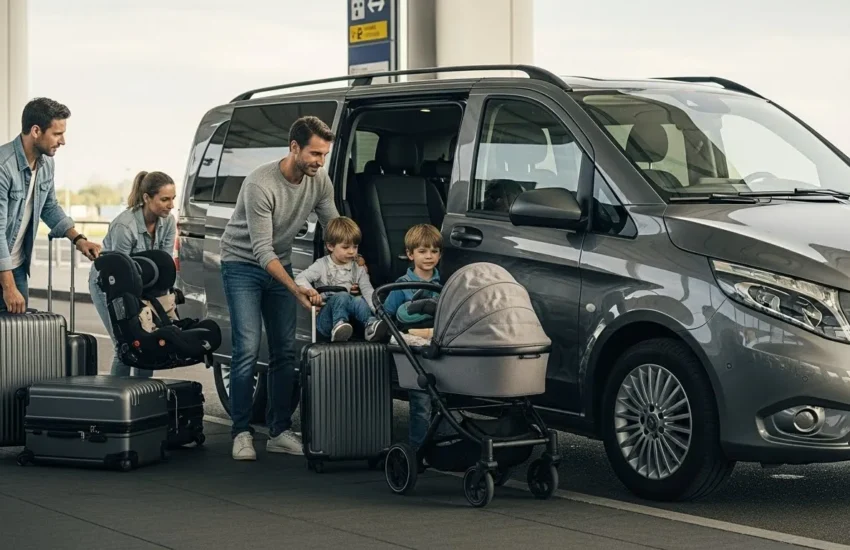
Pushchairs, travel cots, changing bags, and toys create luggage ecosystems rather than luggage stacks. These ecosystems require space to function, not just space to fit.
When family luggage is forced into tight or improvised configurations, parents lose access, children lose comfort, and the journey becomes reactive rather than controlled.
Why Seating Configuration Matters More Than Seat Count
In family travel, seating order is not cosmetic. It determines:
- whether parents can attend to children
- whether children feel visually secure
- whether movement is manageable
A child seated far from a caregiver may feel isolated. A caregiver blocked by luggage cannot respond quickly. These are not minor inconveniences; they shape the emotional climate of the journey.
Vehicles suitable for family travel allow functional adjacency, not just occupancy.
The Role of Child Seats Beyond Legal Compliance
Child seats are often treated as regulatory checkboxes. In practice, they are structural elements that influence vehicle suitability. A vehicle that technically supports child seats may still become impractical once:
- multiple seats are installed
- luggage is loaded
- adults are seated
Each child seat reduces seating flexibility and changes spatial dynamics. This is why family travel planning must consider seat interaction effects, not just seat availability.
Why Airports Intensify Family Travel Stress
Airports compress families into unfamiliar, high-stimulation environments. Noise, crowds, signage, and movement demands overload children quickly.
When families arrive at airports already stressed by a difficult transfer, tolerance for airport complexity drops sharply. Conversely, a calm, predictable transfer creates emotional reserves that families draw on during terminal navigation.
This makes the transfer journey a psychological precursor to the airport experience, not a separate event.
Family Travel and Night or Early-Morning Journeys
Late-night and early-morning transfers disproportionately affect families. Children’s sleep cycles are disrupted, reducing emotional regulation capacity. A child woken abruptly for travel is more sensitive to discomfort, noise, and unpredictability.
In these contexts, vehicle suitability becomes critical. A stable, quiet, spacious environment helps preserve calm. Cramped or noisy conditions escalate distress rapidly.
Family travel logistics must therefore align with biological rhythms, not just schedules.
Why “Making Do” Fails With Families
Adults often tolerate suboptimal conditions out of necessity. Families cannot rely on this tolerance. Children react immediately and honestly to discomfort. There is no buffer of politeness or rationalisation.
This is why improvisation—the mindset of “we’ll manage”—fails disproportionately in family travel. What might be survivable for adults becomes untenable for children within minutes.
Good family travel planning removes the need to improvise.
Family Travel as a Trust-Sensitive Context
Families place higher trust demands on transport providers, even implicitly. Parents are not only evaluating punctuality or comfort; they are assessing whether the environment feels controlled and safe for dependents.
This is why family-oriented travel content belongs in the outer section of a topical map. It builds trust by demonstrating understanding, not by promoting features.
How Vehicle Category Choices Affect Family Travel Outcomes
Vehicle selection is one of the most consequential decisions in family travel, yet it is often made using superficial labels rather than functional understanding. Families frequently associate larger vehicles with inconvenience or unnecessary expense, assuming that “fitting everyone in” is the only relevant criterion. This assumption ignores how vehicle geometry, seating flexibility, and internal circulation affect family dynamics during travel.
A vehicle that technically accommodates a family may still fail functionally. Narrow doors, low rooflines, or fixed seating arrangements restrict movement and make it difficult for parents to assist children without disrupting the entire cabin. In family travel, vehicles must support interaction, not just occupancy. Parents need to turn, reach, reassure, and adjust without contorting or standing up mid-journey.
This is why family travel suitability emerges from interior usability, not from passenger limits stated on a website.
Why Minibuses Are Often Misjudged by Families
Minibuses are commonly perceived as “too much” for family travel, especially for smaller families. This perception stems from associating minibuses with large groups or commercial use rather than understanding their role as flexibility containers.
For families, minibuses offer advantages that are not immediately obvious. They allow child seats to be installed without forcing awkward seating compromises. They create clear separation between luggage and living space, reducing the sense of crowding that children experience acutely. They also allow parents to move slightly within the cabin, which is often necessary during longer journeys.
In many cases, minibuses are not excessive for family travel; they are proportionate to complexity, especially when children are young or when luggage includes strollers and travel equipment.
Strollers, Pushchairs, and the Geometry Problem
Strollers are one of the most disruptive items in family travel logistics. Their shape does not conform to standard luggage assumptions. Even when folded, they occupy awkward volumes that resist efficient stacking.
In smaller vehicles, accommodating a stroller often requires:
- removing luggage first
- folding seats
- placing items in passenger areas
Each of these actions increases handling time and stress. In contrast, vehicles with higher rooflines and modular cargo areas allow strollers to be loaded without disassembly or rearrangement, preserving journey flow.
This is not about convenience alone. When strollers are difficult to manage, parents experience anticipatory stress, worrying about loading and unloading before it even happens.
Mixed-Age Families and Conflicting Needs
Families rarely consist of uniformly aged children. Mixed-age families introduce conflicting requirements: infants need stability and quiet, toddlers need space and reassurance, older children need legroom and stimulation.
A single vehicle configuration must serve all these needs simultaneously. Smaller vehicles struggle to resolve these conflicts without compromise. When compromises accumulate, the emotional load shifts onto parents, who must constantly compensate.
Vehicles suited to family travel reduce the need for parental intervention by providing a neutral, stable environment that does not exacerbate these conflicts.
Long-Distance Airport Transfers With Children
Long-distance airport transfers, such as journeys from outer London boroughs or neighbouring counties, magnify every weakness in family travel planning. Time, space, and fatigue interact.
Children’s tolerance for confinement decreases over time. A configuration that works for twenty minutes may fail catastrophically over ninety. Parents are then forced into continuous management mode, which increases stress and reduces their ability to navigate the airport effectively upon arrival.
Effective family transfer planning treats the vehicle journey as part of the travel experience, not merely a prelude. Comfort during the transfer directly affects behaviour and resilience later.
Seasonal and Weather Effects on Family Travel
Seasonality introduces additional layers of complexity for families. Winter travel involves bulky clothing, reduced dexterity, and increased sensitivity to temperature changes. Summer travel introduces overheating, restlessness, and dehydration risks.
Weather conditions also affect loading time. Rain increases the difficulty of managing children and luggage simultaneously. Cold conditions reduce patience and fine motor control, making straps, buckles, and doors harder to manage.
Vehicles that allow sheltered loading and internal movement reduce exposure and stress during these transitions.
Why Early Errors Have Disproportionate Impact on Families
In family travel, early friction tends to compound. A stressful pickup often sets the emotional tone for the entire journey. Children internalise stress quickly and carry it forward.
Once a child becomes distressed, recovery takes time and energy. This reduces parents’ capacity to handle subsequent challenges such as airport navigation, security checks, or boarding procedures.
This is why family travel logistics must aim for smooth beginnings, not just successful arrivals.
Family Travel and the Concept of Emotional Bandwidth
Emotional bandwidth refers to the capacity to absorb stress without behavioural breakdown. Children have limited emotional bandwidth, and parents’ bandwidth is often already taxed by responsibility.
Transport conditions that consume bandwidth unnecessarily—tight spaces, unpredictable movement, noise—reduce the family’s ability to cope with later stages of travel.
Good family travel planning preserves emotional bandwidth by removing avoidable stressors early.
Why Families Experience Transport Failures More Intensely
Transport failures that might be shrugged off by adult travellers—minor delays, discomfort, confusion—feel amplified in family contexts because they involve dependents. Parents interpret failures not just as inconveniences, but as threats to safety, wellbeing, or control.
This is why dissatisfaction from family travel failures tends to be deeper and longer-lasting. Families remember bad journeys vividly and avoid repeating them.
Educational content that helps families understand constraints and plan accordingly directly improves long-term trust and satisfaction.
Final Perspective
Family travel is not about transporting more people; it is about protecting vulnerability under movement. Children transform travel from a logistical exercise into a responsibility-laden process where comfort, predictability, and emotional stability matter as much as timing.
When family travel is planned with these realities in mind, journeys become calmer, safer, and more resilient. When it is treated as a scaled-up adult journey, even minor issues escalate quickly.
Understanding family travel considerations is therefore not optional for any transport source that claims authority. It is foundational.
