
Executive Summary
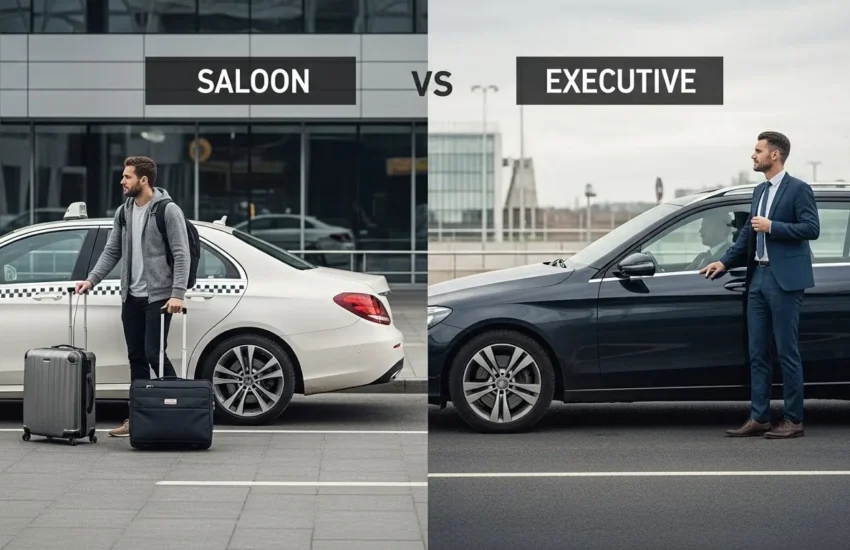
The distinction between saloon and executive vehicles in London private transport is frequently misunderstood. Many passengers interpret the difference as purely cosmetic or status-based, assuming executive vehicles are simply “better” versions of saloons. In reality, saloon and executive vehicles are designed for different use cases, optimised around different priorities such as ride characteristics, cabin environment, luggage compatibility, and journey context.
This article explains the functional, behavioural, and situational differences between saloon and executive vehicles. Rather than comparing features superficially, it examines how each vehicle category performs under real airport transfer conditions, business travel scenarios, and longer-distance journeys. The goal is not to influence booking decisions directly, but to clarify expectations so that vehicle choice aligns with journey intent rather than assumption.
Why the Saloon vs Executive Distinction Causes Confusion
Passenger confusion arises because saloon and executive vehicles often share:
- Similar external dimensions
- Comparable seating capacity
- Overlapping luggage limits
From the outside, they appear interchangeable. The differences lie not in size, but in design philosophy.
A saloon vehicle is engineered to be a general-purpose transport solution. An executive vehicle is engineered to be a controlled environment. This distinction affects how each vehicle behaves across comfort, noise, handling, and passenger experience.
What a Saloon Vehicle Is Designed to Do Well
Saloon vehicles represent the baseline configuration for licensed private transport in London. Their design priorities include:
- Fuel efficiency
- Balanced ride characteristics
- Cost-effective operation
- Practical passenger transport
They are optimised for predictability, not indulgence.
In airport transfer contexts, saloon vehicles perform well when:
- Passenger numbers are low
- Luggage volume is moderate
- The journey purpose is functional rather than experiential
Saloon interiors are typically designed to accommodate frequent passenger turnover, with durable materials and straightforward layouts.
The Saloon Vehicle as a Functional Transport Tool
A key strength of saloon vehicles is operational efficiency. They handle stop-start traffic, congestion, and urban driving patterns with consistency. For many passengers, particularly those familiar with London travel conditions, this predictability is preferable to enhanced luxury.
Saloon vehicles also tend to offer:
- More neutral ride feedback
- Direct steering response
- Familiar cabin layouts
This makes them suitable for passengers who value clarity over isolation during travel.
What Executive Vehicles Are Designed to Prioritise
Executive vehicles shift the design focus from transport efficiency to passenger environment control. Their engineering priorities include:
- Cabin noise reduction
- Suspension smoothing
- Interior material refinement
- Visual and tactile consistency
Rather than responding sharply to road conditions, executive vehicles are designed to absorb and neutralise them.
This design philosophy makes executive vehicles particularly suitable for journeys where mental state, comfort continuity, or professional composure matters.
Why Executive Vehicles Feel Different Even at Similar Speeds
Executive vehicles often feel slower or calmer even when travelling at the same speed as saloons. This is not accidental. It results from:
- Acoustic insulation
- Softer suspension tuning
- Reduced vibration transmission
These characteristics reduce sensory input. For some passengers, this is relaxing. For others, it can feel detached or unfamiliar.
Understanding this difference is crucial. Executive vehicles are not universally “better”; they are different by intent.
Saloon Vehicles in Airport Transfer Use Cases
Saloon vehicles are well suited to airport transfers when:
- The journey is short to medium distance
- Traffic variability is expected
- The passenger prioritises efficiency over ambience
For frequent travellers, saloons often feel practical and unobtrusive. They do not demand adjustment or adaptation; they simply function.
Saloon vehicles also tend to load and unload luggage quickly due to straightforward boot layouts and lower ride heights.
Executive Vehicles in Airport Transfer Use Cases
Executive vehicles are better suited to airport transfers when:
- The journey is long
- The passenger is arriving from or departing to extended travel
- Mental decompression or preparation is important
For example, passengers arriving after long-haul flights often benefit from the reduced noise and smoother ride of executive vehicles.
However, this comes with trade-offs. Executive vehicles may:
- Have slightly reduced luggage flexibility
- Take longer to load due to interior protection requirements
These factors are rarely visible to passengers until experienced.
Business Travel and the Role of Vehicle Environment
Business travellers often default to executive vehicles under the assumption that professionalism equals luxury. In practice, the appropriateness depends on journey function.
Saloon vehicles are effective for:
- Internal meetings
- Short transfers
- Time-sensitive travel
Executive vehicles are more appropriate when:
- Confidential discussions may occur
- Mental focus is required during travel
- The journey acts as a buffer between engagements
The decision is less about image and more about cognitive context.
Luggage Considerations: A Hidden Differentiator
While both vehicle types typically advertise similar luggage capacity, real-world performance differs subtly.
Saloon vehicles often allow:
- Slightly more flexible boot loading
- Less restrictive interior protection
Executive vehicles prioritise interior preservation. Drivers may be more cautious about how luggage is placed, particularly with rigid or heavy items.
This does not mean executive vehicles carry less luggage, but rather that loading constraints are tighter.
Why Executive Vehicles Are Not Automatically Better for Groups
Groups sometimes assume that upgrading to an executive vehicle improves group comfort. In reality, executive vehicles are optimised for individual or paired travel.
Rear seating layouts often prioritise symmetry and comfort over spatial flexibility. For three rear passengers, saloon vehicles may feel more accommodating despite lower perceived status.
Ride Characteristics and Passenger Perception
Saloon vehicles communicate road conditions more directly. Executive vehicles filter them.
Some passengers prefer to feel:
- Road feedback
- Acceleration cues
- Traffic flow changes
Others prefer:
- Isolation
- Smoothness
- Sensory reduction
Neither preference is superior. The mismatch occurs when passengers select a vehicle based on assumption rather than preference.
Why Cost Differences Exist Without Proportional Feature Differences
Passengers often question why executive vehicles cost more when visible differences seem minor. The answer lies in:
- Vehicle acquisition cost
- Maintenance complexity
- Depreciation rates
- Operating standards
These costs are embedded in the service model, not necessarily in visible luxury features.
London’s Regulatory Context and Vehicle Categorisation
In London, both saloon and executive vehicles must meet TfL licensing standards. This means:
- Safety compliance is identical
- Driver vetting is identical
- Legal protections are identical
The difference lies purely in vehicle configuration, not regulatory treatment.
Reference: TfL private hire vehicle licensing framework
Why Passenger Expectations Matter More Than Vehicle Category
Most dissatisfaction occurs not because a vehicle is unsuitable, but because it fails to match expectations.
Passengers expecting luxury from a saloon will be disappointed. Passengers expecting practicality from an executive vehicle may feel constrained.
Expectation alignment is therefore more important than category selection.
Closing Perspective
The choice between a saloon and an executive vehicle is not a question of quality, but of contextual fit. Each vehicle type is optimised for different priorities, and neither universally outperforms the other.
When passengers understand this distinction, journeys become aligned with intent rather than assumption, and satisfaction increases without any change in service level.
